
FAQ (Frequently Asked Questions)
How can we place an order (materials, dimensions, product code)?
To place an order for any Marine Lite product, including marine safety signage and Low Location Lighting (LLL) systems, please provide:
- Product code
- Required dimensions
- Material type
- Quantity
- Delivery location
Are our marine safety sign designs compliant with SOLAS, IMO and ISO standards?
Yes. All marine safety signage and LLL systems are manufactured in accordance with SOLAS Convention requirements, applicable IMO Resolutions, ISO 15370 and DIN 67510 standards.
Products are suitable for flag state inspections, port state control and class society approval.
Can marine safety signs be translated into other languages?
Yes. Upon request, we manufacture marine safety signage in multiple languages while maintaining ISO-recognized safety symbols and SOLAS-compliant specifications.
What are the performance and technical guarantees of our photoluminescent signs?
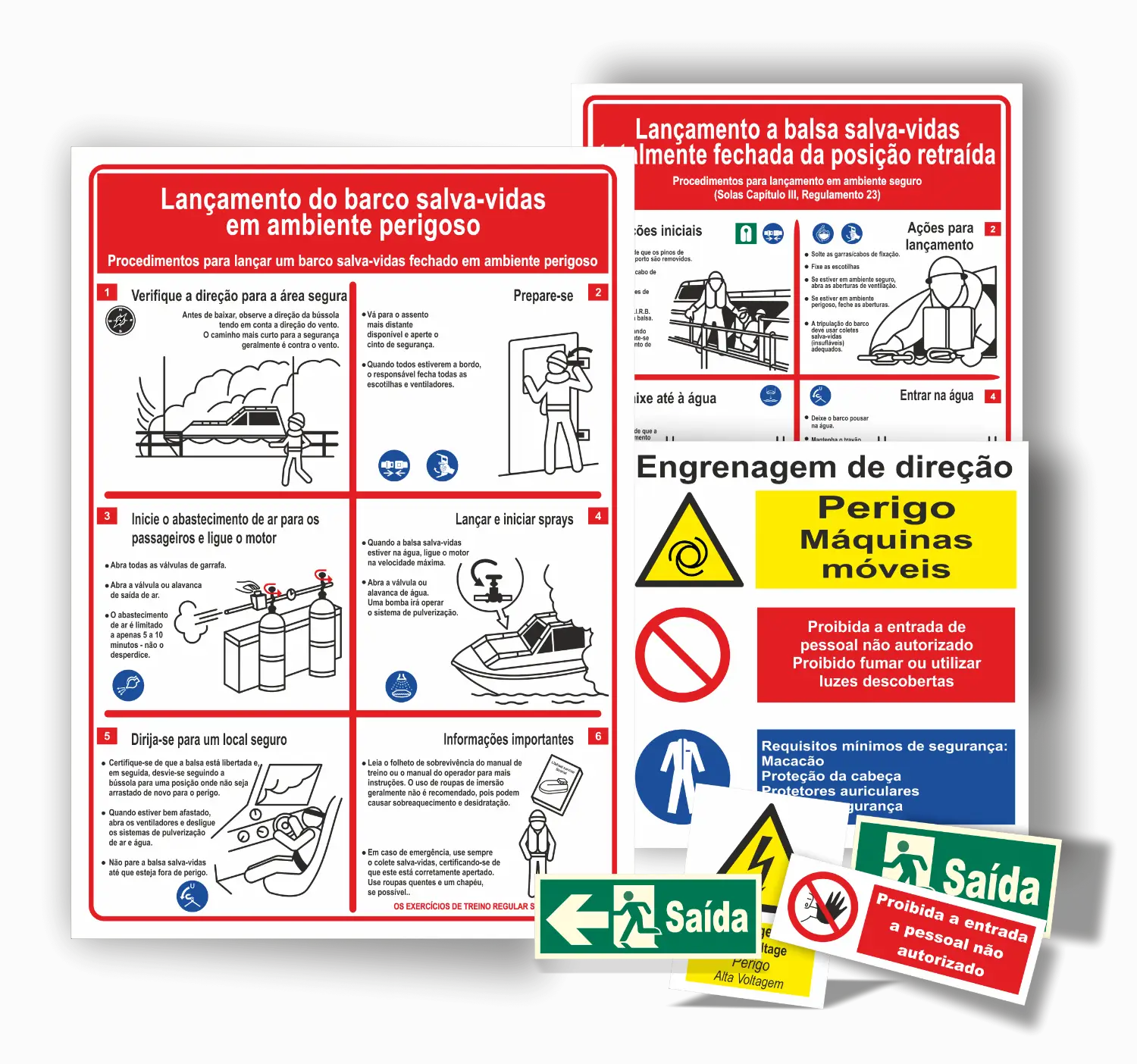
The photoluminescent properties and performance values are printed on all Marine Lite marine safety signs in accordance with the latest requirements.
This aligns marine safety signage with other onboard certified safety equipment where technical specifications are clearly indicated.
- Sign replacement & lifecycle: Performance and visibility may be affected over time due to environmental conditions and operational wear. You may consult our article: How Often Must Marine Safety Signs Be Replaced?
What are the installation procedures for self-adhesive and rigid signs?
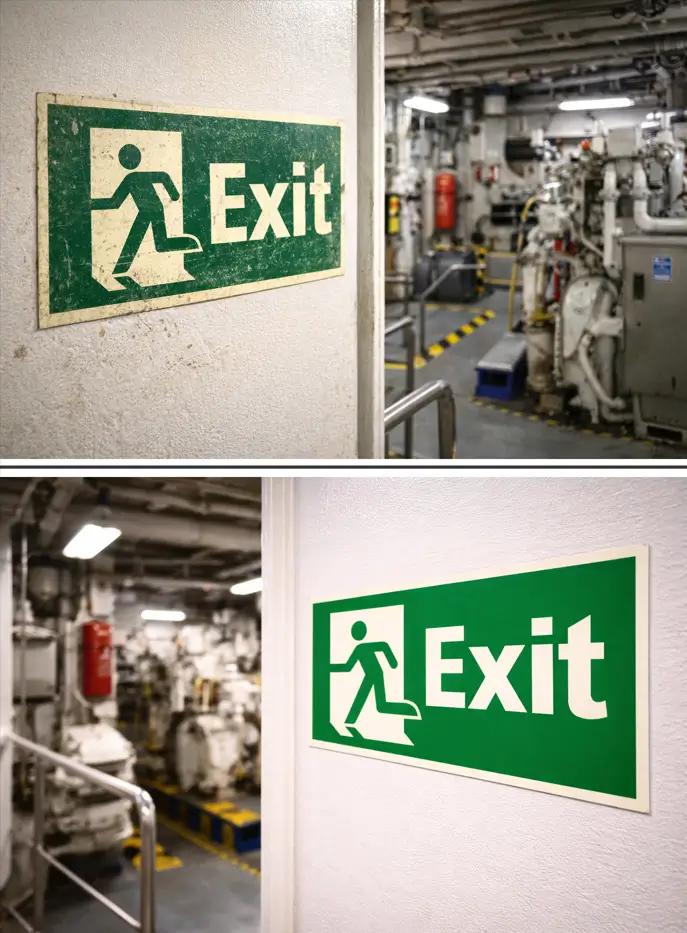
Self-adhesive signs:
- Apply on clean, dry and smooth surfaces
- Surface must be free from grease and dust
- Not suitable for porous or emulsion-painted surfaces
Rigid signs:
- Can be mechanically fixed (drilled and screwed)
- Can be mounted using approved marine-grade adhesive systems
What LLL classes do we supply and what do they mean?
We supply Low Location Lighting (LLL) materials in Class B, Class C and Class D, in accordance with ISO 15370 and DIN 67510.
- Class B: 50 mcd/m² (10 min) – 7 mcd/m² (60 min)
- Class C: 140 mcd/m² (10 min) – 20 mcd/m² (60 min)
- Class D: 260 mcd/m² (10 min) – 35 mcd/m² (60 min)
Can LLL performance be measured, and do we provide certification?
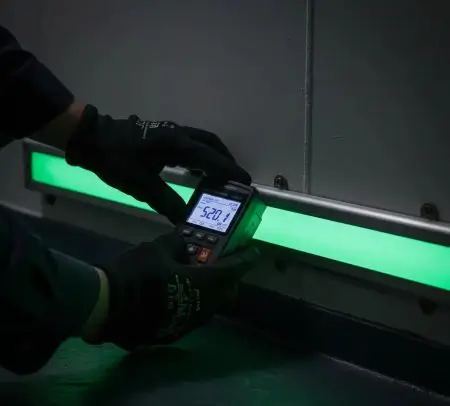
Yes. We can measure Low Location Lighting (LLL) performance in accordance with SOLAS requirements and ISO 15370 / DIN 67510.
Upon request, we provide a measurement report/certificate documenting the measured performance values. The measurement certification is valid for five (5) years, provided no material modifications, replacements or damage occur.
For more details regarding testing and certification procedures, you may consult our article: Low Location Lighting (LLL) Systems on Passenger Ships – Test & Measurement Certificate.
What are our delivery and logistics options?
We provide worldwide shipping, bulk production capability and secure packaging suitable for marine transport and shipyard delivery. Express production and delivery options are available upon request.
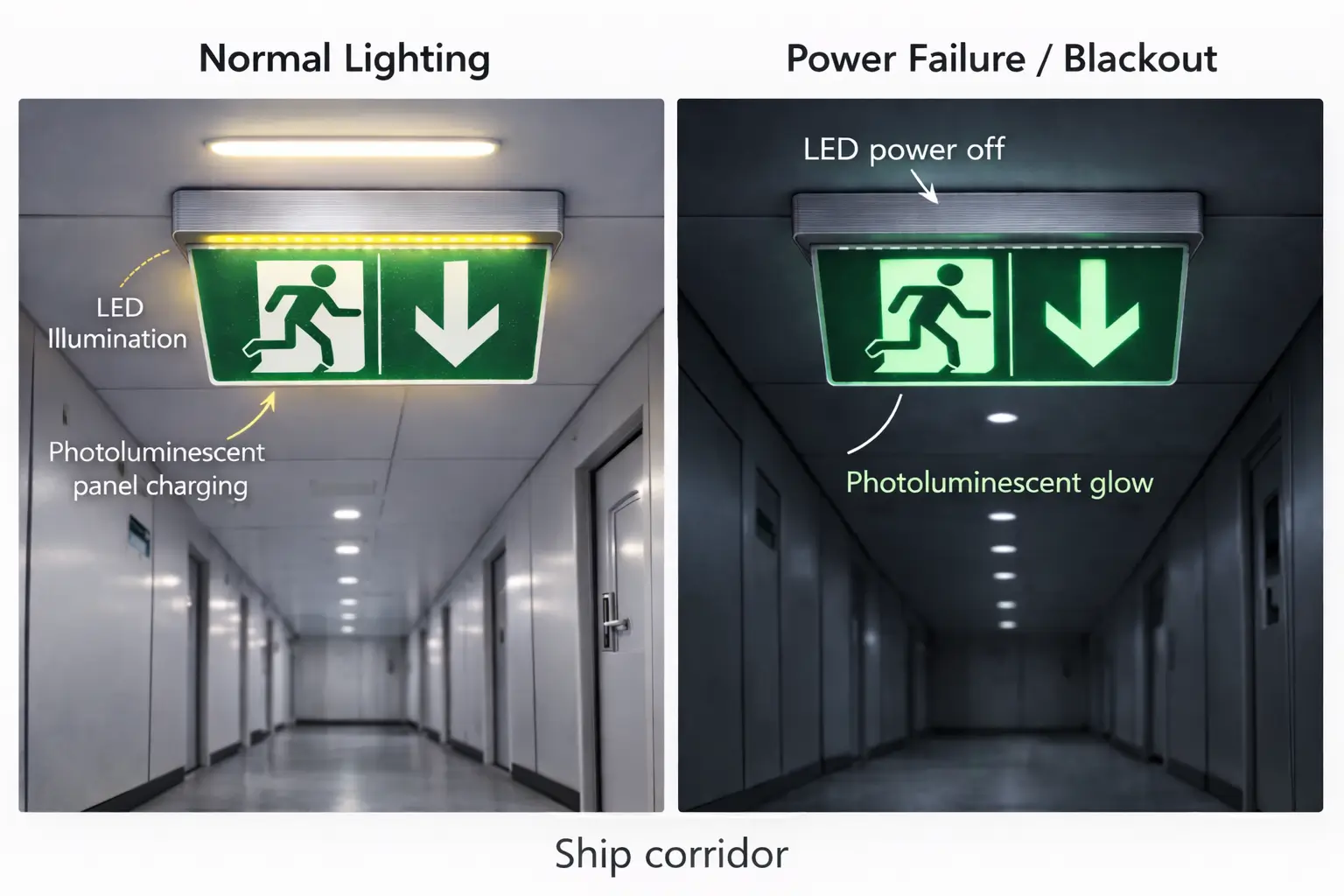
What happens to LED-photoluminescent signs during a power failure or blackout on ships?
Standard LED safety signs or LED escape signs rely on electrical power to remain illuminated. If the electrical supply is interrupted, their visibility depends on emergency backup systems.
Photoluminescent safety signs absorb ambient light and emit visible light in darkness without requiring electricity. This allows them to remain visible during power failures or blackout conditions and helps maintain guidance along emergency escape routes on ships.
In some applications, LED-photoluminescent escape signs are used. These combine LED illumination with photoluminescent materials, allowing the sign to charge under LED or ambient light while maintaining visibility in darkness and during emergency situations.
Ready to Secure Your Vessel?
Contact our experts today for custom marine safety signage, LLL systems, or compliance consultation.
Get in Touch with Marine Lite