
IALA Buoyage System Explained: Region A vs Region B and the Six Types of Marks
The IALA Maritime Buoyage System is the international set of rules that tells mariners what a buoy or beacon means from its colour, shape, topmark and light. It uses six types of marks (lateral, cardinal, isolated danger, safe water, special and emergency wreck) and divides the world into two regions, A and B. Only the lateral marks change between the two: in Region A red marks the port side of a channel, in Region B it marks the starboard side.
Ships on worldwide trade cross between the two regions regularly. A vessel sailing from Europe, Africa or the Gulf to the Americas, Japan, the Republic of Korea or the Philippines moves from Region A into Region B, and its crew has to switch convention.
IALA today: from association to intergovernmental organization
The body behind the buoyage system has changed its legal status. IALA is now the International Organization for Marine Aids to Navigation. Until 2024 it was the International Association of Marine Aids to Navigation and Lighthouse Authorities, a non-governmental organization (NGO). The acronym IALA stayed the same.
The change took effect on 22 August 2024, when the IALA Convention entered into force and IALA became an intergovernmental organization (IGO). Its first General Assembly as an IGO met in Singapore on 18–20 February 2025.
The buoyage rules themselves are set out in IALA Recommendation R1001, The IALA Maritime Buoyage System (MBS), Edition 2.0, June 2023.
Region A vs Region B: the lateral mark divide
Of the six types of marks, only one depends on where the ship is. Lateral marks, which show the sides of a channel, swap colours between Region A and Region B. Cardinal, isolated danger, safe water, special and emergency wreck marks look and work the same everywhere.
The two regions were agreed in 1980, as the compromise that made a single IALA Maritime Buoyage System possible.
| Region | Port hand mark | Starboard hand mark | Where it is used |
|---|---|---|---|
| Region A | Red, can (cylinder) topmark | Green, cone topmark pointing up | Europe, Australia, New Zealand, Africa, the Gulf and some Asian countries |
| Region B | Green, can (cylinder) topmark | Red, cone topmark pointing up | The Americas, Japan, the Republic of Korea and the Philippines |
Watch the mnemonic. "Red right returning" is a Region B rule. In Region A a vessel returning from seaward keeps the red marks to port, so applying it in Region A waters such as Europe puts the ship on the wrong side of the channel.
For any fleet trading between the two regions, this is a practical point, not a theoretical one. Officers who have spent most of their career in one region should refresh the other convention before arrival, rather than try to recall it during pilotage.
Direction of buoyage: what makes a mark "port" or "starboard"
A lateral mark only means port or starboard in relation to the direction of buoyage.
Approaching from seaward
By convention, the direction of buoyage is the general direction a vessel takes when approaching a harbour, river, estuary or waterway from seaward. An inbound ship reads the marks as charted. An outbound ship passes the same marks on the opposite side: leaving harbour in Region A, it keeps the red marks to starboard.
Clockwise around land masses
Where there is no obvious harbour approach, the competent authority sets the direction. In principle it runs clockwise around land masses, and it is always shown on charts and in nautical documents. Never assume it from the shape of the coast.
Topmarks and preferred channels
The topmark shape follows the side of the channel, not the region. When fitted, a can topmark always marks the port side and a cone the starboard side, in Region A and Region B alike.
Where a channel divides, a modified lateral mark shows the preferred channel. In Region A, a red mark with one broad green band means the preferred channel is to starboard, and a green mark with one broad red band means it is to port. Both show a composite group flashing (2+1) light. In Region B the colours are reversed.
The six types of IALA marks at a glance
Apart from the lateral marks, every mark means the same thing in both regions. The table shows how to recognize each one by day and by night.
| Mark | What it tells you | Colours | Topmark | Light |
|---|---|---|---|---|
| Lateral | The port and starboard sides of a channel | Red or green, depending on the region | Can (port) or cone (starboard) | Red or green, matching the mark |
| Cardinal | Where the safer water lies, by compass quadrant | Black and yellow horizontal bands | Two black cones | White, quick (Q) or very quick (VQ) |
| Isolated danger | A danger with navigable water all around it | Black with one or more broad red bands | Two black spheres | White, group flashing (2) |
| Safe water | Navigable water all around; no danger | Red and white vertical stripes | One red sphere | White: isophase, occulting, one long flash every 10 s, or Morse "A" |
| Special | A special area or feature | Yellow | Yellow X | Yellow |
| Emergency wreck | A new danger, such as a newly discovered wreck | Blue and yellow vertical stripes (4 to 8) | Yellow cross | Alternating blue and yellow, 1 s each with a 0.5 s eclipse |
An isolated danger mark sits on a danger that has navigable water all around it. A safe water mark is the opposite: it has navigable water all around it, marks no danger, and is used for fairway, mid-channel and landfall positions. A special mark shows a special area or feature, such as a cable or pipeline, a recreation zone, a spoil ground or a military exercise zone. The emergency wreck mark marks new dangers; if a racon is fitted, it shows Morse "D".
Cardinal marks: how to read them quickly
A cardinal mark is named after the compass quadrant where the safer water lies: you pass north of a north cardinal, east of an east cardinal, and so on. Cardinal marks can also show the deepest water in an area, or the safe side on which to pass a danger.
The quickest memory aid is the topmark: the two black cones point to where the black is on the buoy. All cardinal marks show a white light, quick (Q) or very quick (VQ).
North cardinal
Both cones point up. Black above yellow. Light: continuous VQ or Q.
East cardinal
Cones base to base. Black with one broad yellow band. Light: VQ(3) every 5 s or Q(3) every 10 s.
South cardinal
Both cones point down. Yellow above black. Light: VQ(6) plus a long flash every 10 s, or Q(6) plus a long flash every 15 s. The long flash, of at least 2 seconds, makes sure that the three or nine flashes of the east and west marks cannot be mistaken for six.
West cardinal
Cones point to point, a shape many mariners remember as a wine glass. Yellow with one broad black band. Light: VQ(9) every 10 s or Q(9) every 15 s.
Key takeaways for bridge officers
- Only lateral marks change. The other five types are the same worldwide.
- Region A: red to port, green to starboard when entering from seaward. Region B: red to starboard.
- Topmark shape does not change. Can for port, cone for starboard, in both regions.
- Cardinal marks follow the compass, not the channel. The name tells you on which side the safer water lies.
- Yellow means a special area; blue and yellow means a new danger.
Keeping the system visible on board: the IALA buoyage poster
An IALA buoyage poster on the bridge and in the training room helps officers and cadets recognize marks at a glance. Using the same poster on every vessel also means that crew moving between ships always see the same reference.
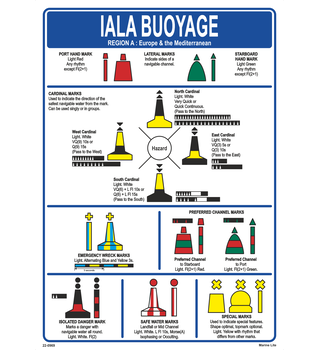
Our IALA buoyage poster (code 22-0969) shows the Region A system used in Europe and the Mediterranean: lateral, cardinal, preferred channel, isolated danger, safe water, special and emergency wreck marks, each with its light characteristics. Marine Lite has manufactured IMO safety signs and posters in Piraeus, Greece, since 2005 and supplies ships worldwide. See also our wider range of training and safety posters.
Frequently asked questions
What is the difference between IALA Region A and Region B?
Only the lateral marks differ. In Region A the port hand mark is red and the starboard hand mark green; in Region B the colours are reversed. Region B covers the Americas, Japan, the Republic of Korea and the Philippines, while Region A covers Europe, Australia, New Zealand, Africa, the Gulf and some Asian countries.
Do cardinal marks change between Region A and Region B?
No. Cardinal marks are the same in both regions, and so are isolated danger, safe water, special and emergency wreck marks. Only the lateral marks change colour.
What are the six types of IALA marks?
Lateral, cardinal, isolated danger, safe water, special and emergency wreck marks. They can be used alone or in combination, and only the lateral marks change between Region A and Region B.
What is an emergency wreck mark?
It marks new dangers, such as a newly discovered wreck. It has blue and yellow vertical stripes (four to eight), a yellow cross topmark and a light that alternates blue and yellow, one second each with a half-second eclipse. If a racon is fitted, it shows Morse "D".
What is IALA's new name?
Since 22 August 2024 IALA has been the International Organization for Marine Aids to Navigation, an intergovernmental organization. It was previously the International Association of Marine Aids to Navigation and Lighthouse Authorities, and the acronym IALA has been kept.
Need IALA posters or IMO safety signs for your fleet?
Tell us what you need and we will send you a quote.
Sources: IALA – The Organization; IALA Recommendation R1001, The IALA Maritime Buoyage System (MBS), Edition 2.0.