
IMDG Labels, Placards and Marks Explained: Classes, UN 3077 and the 42-24 / 43-26 Amendments
IMDG labels go on packages and IMDG placards go on cargo transport units such as containers and tanks. Labels are diamonds of at least 100 mm × 100 mm; placards are at least 250 mm × 250 mm. Amendment 42-24 of the IMDG Code has been mandatory since 1 January 2026, and Amendment 43-26 enters into force on 1 January 2028.
Ships carrying dangerous goods in packaged form, and the ship chandlers who supply them, need the right labels, placards and marks on board and in stock. With Amendment 42-24 now in force and Amendment 43-26 already adopted, this guide sets out what goes where, the minimum sizes, and what the most searched UN numbers mean.
Which IMDG edition applies in 2026, 2027 and 2028
The IMDG Code, 2024 Edition (Amendment 42-24) was adopted by resolution MSC.556(108) on 23 May 2024. It could be applied voluntarily from 1 January 2025 and became mandatory on 1 January 2026. It applies to ships carrying dangerous goods in packaged form.
The next edition, Amendment 43-26, was adopted by the IMO Maritime Safety Committee at its 111th session (MSC 111) in May 2026.
| Date | Edition | Status |
|---|---|---|
| 1 January 2025 | Amendment 42-24 | May be applied voluntarily |
| 1 January 2026 | Amendment 42-24 | Mandatory |
| 1 January 2027 | Amendment 43-26 | May be applied voluntarily; 42-24 remains mandatory |
| 1 January 2028 | Amendment 43-26 | Enters into force |
What changed in Amendment 42-24
Amendment 42-24 replaces the complete text of the Code. Three of its changes matter most for labelling and stowage:
- Sodium-ion batteries have their own entries: UN 3551 and UN 3552.
- Vehicles powered by sodium-ion or lithium batteries have new entries, UN 3556 to UN 3558, assigned to Class 9.
- A new stowage provision: flammable gases or liquids with a flashpoint below 23 °C must be stowed away from potential sources of ignition.
New UN numbers also mean new orange panels. A consignment declared under one of these entries needs a panel or placard showing the right four digits.
The nine dangerous goods classes
Every label starts with classification. The class decides which hazard diamond the package and the cargo transport unit carry.
| Class | Name |
|---|---|
| Class 1 | Explosives |
| Class 2 | Gases |
| Class 3 | Flammable liquids |
| Class 4 | Flammable solids; substances liable to spontaneous combustion; substances which, in contact with water, emit flammable gases |
| Class 5 | Oxidizing substances and organic peroxides |
| Class 6 | Toxic and infectious substances |
| Class 7 | Radioactive material |
| Class 8 | Corrosive substances |
| Class 9 | Miscellaneous dangerous substances and articles |
Labels vs placards vs marks
A label goes on a package. A placard goes on a cargo transport unit, such as a freight container or a tank, and is the same diamond on a larger scale. Its symbol and colours match the label for the same class.
| Item | Where it goes | Minimum size |
|---|---|---|
| Label | Packages | 100 mm × 100 mm diamond, with a line 5 mm inside the edge |
| Placard | Cargo transport units (containers, tanks) | 250 mm × 250 mm diamond, with a line 12.5 mm inside the edge; class number at least 25 mm high |
| Marine pollutant mark | Packages and cargo transport units | 100 mm × 100 mm on packages; 250 mm × 250 mm on cargo transport units |
| Orange panel (UN number) | Cargo transport units, next to the placard or marine pollutant mark | 120 mm high × 300 mm wide, with a 10 mm black border |
On a cargo transport unit the UN number is shown in one of two ways: in the white area of the placard below the symbol, or on an orange panel next to the placard or the marine pollutant mark.
What is UN 3077?
UN 3077 is ENVIRONMENTALLY HAZARDOUS SUBSTANCE, SOLID, N.O.S., in Class 9. "N.O.S." means "not otherwise specified": the entry is used for substances that have no specific name of their own in the Code.
Its liquid counterpart is UN 3082, ENVIRONMENTALLY HAZARDOUS SUBSTANCE, LIQUID, N.O.S., also Class 9. The two are easy to confuse, so check the physical state before choosing the panel.
What is UN 1993?
UN 1993 is FLAMMABLE LIQUID, N.O.S., in Class 3. Like UN 3077, it is a generic entry for substances without a specific name, here flammable liquids.
The marine pollutant mark
The marine pollutant mark is a diamond with a fish and tree symbol, in black on white or on a suitable contrasting background. It is not a class label, so it does not carry a class number.
The minimum size is 100 mm × 100 mm on packages and 250 mm × 250 mm on cargo transport units, the same as the class label and placard.
Getting labels and placards ready on board
A short check of the labels and placards on board, or in a chandler's stock, avoids last-minute problems before loading:
- Edition: work to Amendment 42-24, mandatory since 1 January 2026, and plan ahead for 43-26 from 2028.
- Sizes: labels at least 100 mm, placards and marine pollutant marks on units at least 250 mm, orange panels 120 mm × 300 mm.
- UN numbers: stock orange panels for the UN numbers you carry most, including the new entries such as UN 3551 to UN 3558.
- Solid or liquid: UN 3077 is for solids, UN 3082 for liquids.
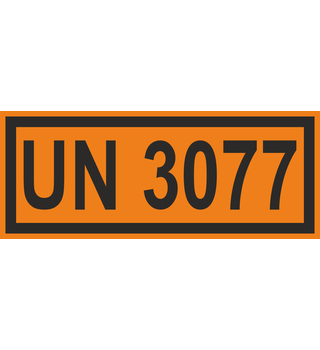

Our UN 3077 orange panel (code 17-0343) is made in 12 cm × 30 cm self-adhesive vinyl, and our marine pollutant mark (code 17-0110) comes in 10 cm × 10 cm for packages and 25 cm × 25 cm for cargo transport units. See the full range of IMDG dangerous goods labels and placards. Marine Lite has manufactured IMO safety signs, posters and placards in Piraeus, Greece, since 2005 and supplies ships worldwide.
Frequently asked questions
Which IMDG Code amendment is mandatory in 2026?
Amendment 42-24, the IMDG Code 2024 Edition, became mandatory on 1 January 2026. It was adopted by resolution MSC.556(108) and could be applied voluntarily from 1 January 2025.
When does IMDG Amendment 43-26 apply?
Amendment 43-26 may be applied voluntarily from 1 January 2027 and enters into force on 1 January 2028. It was adopted at MSC 111 in May 2026.
What is the difference between an IMDG label and a placard?
A label goes on a package and is at least 100 mm × 100 mm. A placard goes on a cargo transport unit, such as a container or a tank, and is at least 250 mm × 250 mm. Both are diamonds with the same symbol and colours for each class.
What is UN 3077?
UN 3077 is ENVIRONMENTALLY HAZARDOUS SUBSTANCE, SOLID, N.O.S., in Class 9. Its liquid counterpart is UN 3082, ENVIRONMENTALLY HAZARDOUS SUBSTANCE, LIQUID, N.O.S.
What size is an IMDG placard?
At least 250 mm × 250 mm, with a line 12.5 mm inside the edge and a class number at least 25 mm high. The UN number goes in the white area below the symbol or on an orange panel at least 120 mm × 300 mm.
Need IMDG labels, placards or orange panels?
Tell us the UN numbers, classes and quantities and we will send you a quote.
Sources: IMO – IMDG Code; Hong Kong Marine Department – Amendment 42-24; Britannia P&I – MSC 111 update; IMDG Code, Part 5 (chapters 5.2 and 5.3) for labels, placards, marks and orange panels.